Why Choir Concerts Lose Money
Some choirs consistently sell out every show, generating vital revenue. Others struggle, singing to half-empty halls while wondering what went wrong.
For any singing group that relies on performances for income, mastering ticket sales is critical. This comprehensive guide will break down how ticket revenue truly works, covering the psychology, pricing strategy, marketing channels, and the systems you need to build a top-notch, loyal audience.
The Core Ticket Revenue Equation
Ticket revenue is fundamentally a three-part equation:
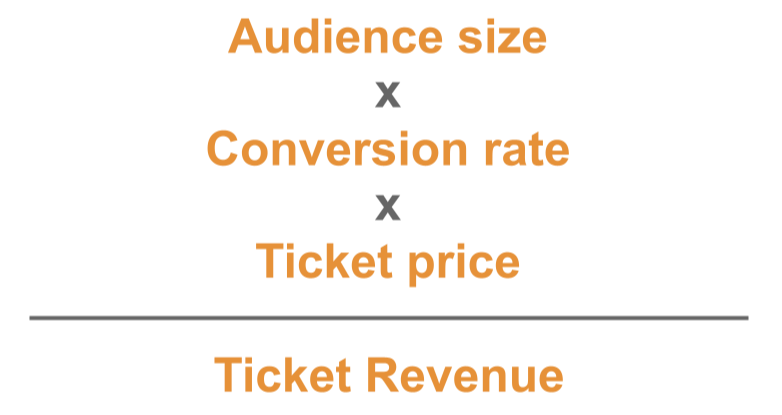
For example, if you reach 10,000 potential buyers, convert 5% of them (500 ticket sales), and your average ticket costs $20, that results in $10,000 in revenue.
Audience size is the total number of potential ticket buyers you can reach, which is entirely a matter of your marketing channels.
Conversion rate is the percentage of those potential buyers who take action, which is determined by your marketing effectiveness within those channels.
Average price is something you control directly, and you should actively optimize it.
Let's begin by discussing pricing.
Mastering Your Pricing Strategy
Most choirs make a critical mistake: they set their prices once and never evaluate them. If you haven't spent years actively testing and discovering your optimal base price, you simply don't know what it should be.
1. Psychology of Pricing
The Perception of Value: Selling tickets too cheaply can make people think less of your product, much like wine. If the price is low, the perceived quality is often low, regardless of the artistic merit. For the same reason, setting the base price higher than you think you should can increase the perceived quality of the performance.
The Power of the Deal: Set a healthy base price, and then offer discounts so people feel like they got a deal. This strategy maintains perceived value while incentivizing action.
2. Pricing Tactics to Drive Action
Early Bird & Scarcity: Phrases like "Early bird ends Friday" or "Only 120 seats left" convert procrastinators into buyers. If you don't create urgency, many people who intend to come simply won't.
Tiered Pricing: Implement Premium, Standard, and Student pricing. This allows the market to sort itself out, capturing maximum revenue from different willingness-to-pay segments.
Bundles: Increase the average revenue per buyer by offering bundles:
Ticket + Donation
Ticket + Post-Reception or VIP Experience
Season Packages
3. Venue and Capacity Strategy
The biggest financial mistake a choir can make is renting a hall that is either too expensive or too large for their current audience. Your venue is probably your largest cost and certainly your greatest capacity constraint—treat it like a part of your financial model, not just a place to sing.
Capacity-Audience Match: Always choose a venue where a sell-out feels achievable. Performing to a 50%-full 500-seat hall is less profitable (and less fun) than performing to a 90%-full 200-seat hall. The smaller hall likely has lower rental fees and provides an atmosphere of scarcity and success.
Cost-Smart Venue Negotiation: Don't pay sticker price. Many non-profit venues, churches, or schools offer reduced rates for arts organizations, especially if you can commit to mid-week or off-peak slots. Always ask about package deals, in-kind services (like access to their ticketing system), and whether they can waive or reduce high fees like custodial or security costs.
Seating Configuration Strategy: Use your venue layout to reinforce your tiered pricing. If your hall is general admission, clearly define "Premium" seating sections (front rows, center) that have a higher price point. This maximizes the revenue potential within your space by ensuring patrons who are willing to pay more can do so for a better experience.
Channels: How Tickets Actually Get Sold
Ticket sales rely on a strong combination of marketing, product quality, and robust systems. Choirs typically use four primary channels:
1. Members Selling Tickets
If you have 80 singers and each sells 5 tickets, that’s 400 seats filled before any external advertising. This channel works best when:
You have a large number of members.
The members are highly motivated.
You clearly equip them with tools and a process.
Motivation: The best motivation is member pride in the artistic product. They want their friends and family to see them succeed. While some groups use heavy-handed agreements (requiring a minimum number of sales), the most sustainable approach is providing genuine motivation.
Training: Give your members templated emails, best practices, and encourage personal outreach—personal calls and texts are always more compelling than easily ignored emails. Remember: Your members are your distributed sales force. Celebrate your top sellers.
2. Your Existing Audience (Email List)
Your email list—especially patrons who enjoyed your last show—is your most valuable asset. These people already like you and are your highest-converting buyers.
Engagement is Key: Follow up with your audience before and after the concert:
Announce the next show early to build anticipation.
Thank them for attending immediately after the show.
Send follow-up communications with photos, clips, and feedback requests.
Ticket revenue compounds when audience relationships compound.
3. Partnerships & Collaborations
Collaboration is leverage. By partnering with another entity, you tap into someone else’s audience.
A headliner or guest artist with a strong following.
Another ensemble or choir.
A local business, school, or church.
A good partner will either help you promote to their audience or give you something exciting and new to advertise to your own audience.
4. Advertising
Advertising is how you move beyond your internal circle to find new, long-term fans. It’s the way to build up your fan base over time, beyond the friends and family of your singers and past patrons.
The most crucial aspect of advertising to a fresh audience is putting yourself in their shoes: Why would they want to come?
Your show needs a compelling "hook," and your ads must communicate that hook effectively. The best advertising results come from four actions:
Create visuals and copy that grabs attention with a strong hook.
Target the message to people who don't know you.
The call to action (CTA) must be strong and simple.
The purchase flow must be frictionless, as these are not yet highly motivated buyers.
Sponsorships and Grants for Financial Leverage
While collaboration can mean cross-promotion, the most powerful collaboration is one that offers direct financial support. Sponsors and grants serve as leverage to cover fixed production costs, reducing the pressure on ticket sales to turn a profit.
The Corporate Sponsorship Package: Businesses want access to your audience. Build a simple 3-tier sponsorship package (e.g., Bronze, Silver, Gold). Their investment is their ticket to access your patrons, and their benefits can include:
Logo placement on the program and website.
Verbal recognition from the stage during the concert.
Complimentary tickets for their staff or clients (which maintains your high perceived ticket value).
Targeted Grant Applications: Grants are not just for artistic programming; many exist to cover specific logistical costs. Look for "Community Engagement" or "Arts Access" grants that can be specifically earmarked to cover venue rental or marketing costs. By covering your biggest fixed expenses with grant money, you ensure that every ticket sold is almost pure profit. A successful grant application turns a concert from an expense to a revenue engine.
We will get directly into the details about sponsorships and grants in future episodes of this series.
The Purchase Experience and Retention
A smooth system doesn’t just sell this show; it builds the next one. You can do everything right and still lose sales if checkout is painful.
The Purchase Experience
Your ticket purchase flow must be:
Mobile-Friendly: A significant number of purchases happen on a phone.
Short: Minimize the number of required fields and clicks.
Clear and Fast: Confusing or slow checkout pages dramatically reduce conversion.
Crucially, capture email addresses for every ticket buyer. This contact information is future revenue. Every extra step you remove from the process reduces friction and increases conversion.
The Show is the Marketing (Retention Strategy)
The ultimate ticket strategy is retention. Arts organizations are often better at getting people to attend once than getting them to come back a second time. Every aspect of the first-time attendee's experience matters:
Lobby atmosphere and welcome.
Intermission energy and engagement.
Program design and clarity.
Post-concert interaction with singers or staff.
Here are simple, concrete steps to keep them coming back:
At curtain call, verbally invite people back for the next performance.
Include the next concert date prominently in the program.
Follow up the next day with a thank-you email.
Ensure you capture and successfully retain their contact information.
Beyond the box office: Modern revenue streams
Don't let the revenue stop after the final note. Modern technology and a focus on year-round engagement allow choirs to generate income from sources entirely separate from physical ticket sales.
Digital Content Monetization: This is pure margin. If you are already recording your concert for archival purposes, why not sell it?
Live Stream / Video-on-Demand (VOD) Access: Sell a separate, lower-priced "Digital Ticket" for patrons who live far away or cannot attend in person.
Digital Downloads/CDs: Offer recordings of past performances as a persistent income stream on your website.
Merchandise Sales: This is a simple but often-ignored tactic. Design high-quality, tasteful merchandise (tote bags, quality t-shirts, branded water bottles) and ensure the sales setup is frictionless. Position the merchandise table in the lobby and ensure members are actively promoting it before the show and during intermission. Merch turns a patron into a walking billboard for your choir, extending your brand awareness and generating profit.
Measure and Improve
Very few choirs measure ticket performance, which is a missed opportunity. Measuring and improving is what will compound your success year over year. You need to know:
Which channel (e.g., email, member sales, specific ad campaign) sold the most tickets.
Your overall conversion rate.
Which emails and ads performed best.
Whether recent pricing changes affected ticket volume.
Collecting this data means your planning for the next concert is based on intelligent choices, not just guessing.
Rating Ticket Revenue
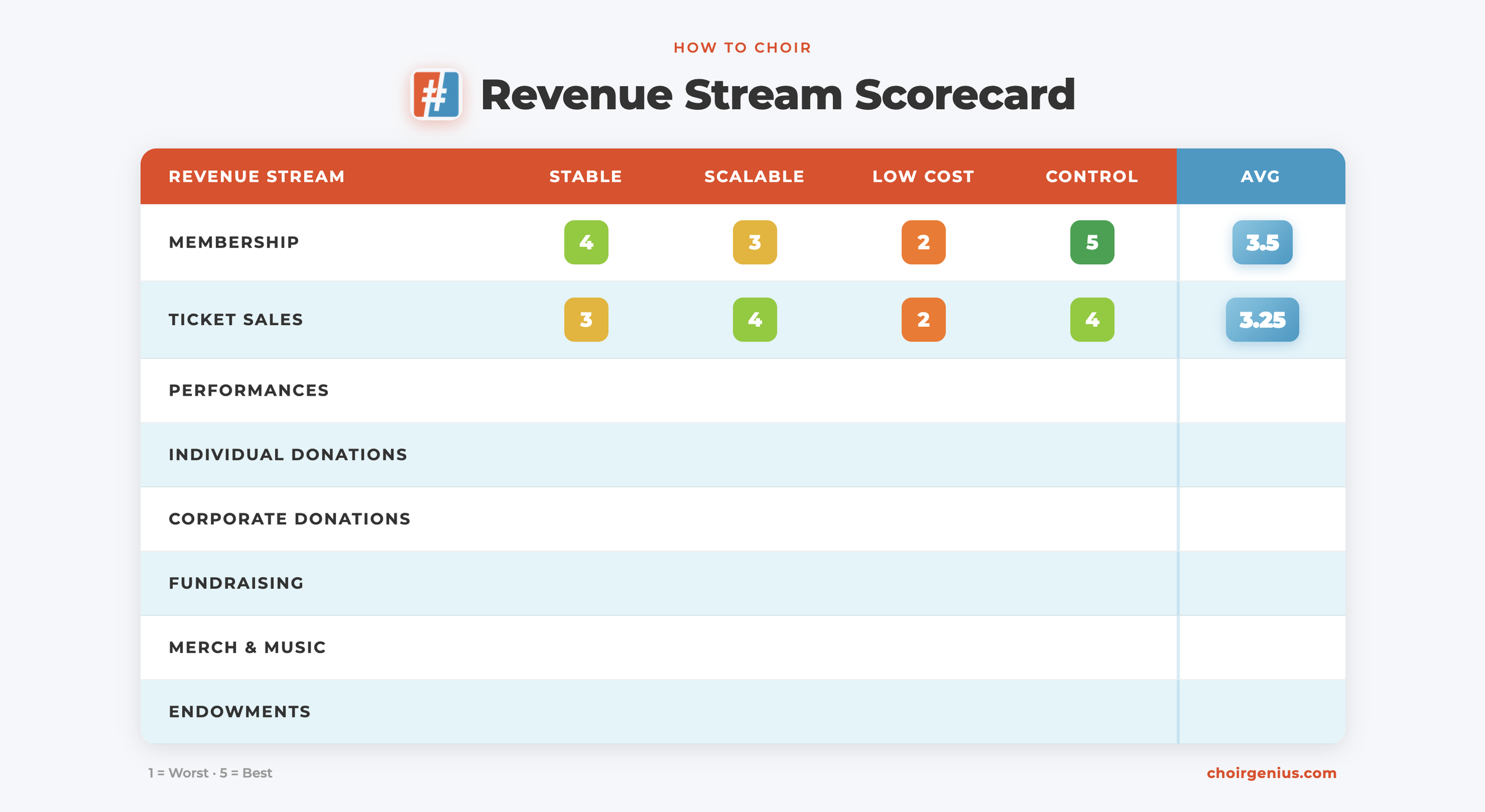
On a revenue streams leaderboard, ticket sales rank as follows:
Stable (3 out of 5): Ticket revenue fluctuates based on programming, marketing quality, timing, and external factors like weather. It is less predictable than fixed membership fees, but more controllable than grants.
Scalable (4 out of 5): There is strong upside potential. Larger venues, additional performances, better marketing, and powerful collaborations can dramatically increase this revenue stream.
Low Cost (2 out of 5): The margins can be low. Marketing spend, venue rental, production costs, and transaction fees all reduce net profit. However, implementing smart systems and effective partnerships can improve overall efficiency.
Control (4 out of 5): You have significant control over the outcome. You directly control pricing, messaging, urgency, partnerships, and the purchase flow. While external factors exist, execution is largely within your hands.
Hopefully, you have learned a lot about selling tickets and building an amazing community of fans and patrons. Next, we will tackle the major revenue stream of donations, which involves a completely different psychology.