The Uncomfortable Truth About Choir Economics: Why Merchandise Still Matters in the Age of Streaming
Back in the 2000s, when I was singing with my quartet, Realtime, our world was analog. We would finish a performance, walk out to the lobby, and sell stacks of CDs. Not just a few—stacks. At major conventions, half our income could come from those physical sales. People were emotionally invested, and they wanted to take that feeling, that memory, home with them.
That world, and those economics, are mostly gone now.
Today, running a vocal ensemble means navigating a marketplace where recorded music has been fundamentally—and perhaps permanently—devalued. Streaming giants, particularly Spotify, taught listeners that music should be instant, infinite, disposable, and nearly free. It transformed music from something people owned into something they temporarily accessed—ambient utility infrastructure, like tap water.
This shift was devastating for independent artists, and for choirs, the situation is uniquely challenging: our music is niche, production is expensive, our audiences often skew older and less streaming-centric, and we simply do not generate the massive replay volume of pop acts. As a direct revenue stream, streaming is usually terrible for choirs.
But this devastation has forced a necessary realization: recordings and merchandise were never just retail products. Today, they are much more often strategic tools.
Part I: The Psychology of Purchase—Selling Belonging, Not Hoodies
Most choir organizations think about merchandise backwards. They ask, "Can we make money selling shirts?"
The better question, which taps into the true driver of sales, is: "Can merchandise strengthen identity, memory, loyalty, and emotional connection?"
Nobody desperately needs another hoodie. People buy for emotional reasons that transcend simple utility. What they are actually acquiring is:
A Memory of Emotion: They want a tangible artifact to preserve the feeling they experienced during a powerful performance.
A Symbol of Belonging: Merch serves as a shared marker of group identity. It’s tribal. Humans inherently seek belonging, and a choir’s community is often deeply identity-based.
Proof of Support: Purchasing is an immediate, actionable way to support the group financially.
Identification: It allows audiences—and singers—to publicly identify with the community and the story of the ensemble.
The strongest choirs are not merely music organizations; they are identity organizations. Sports teams, universities, and churches understood this principle centuries ago. The logo is a symbol of shared experience, ritual, and story. Merchandise is part of that crucial ecosystem.
Part II: Recordings as Assets—Amplifying the Mission
For a long time, we viewed a choir recording as a finished product with a price tag. Now, it must be repositioned as an asset that multiplies the effectiveness of the entire organization.
Recordings are no longer just products; they are marketing assets, community assets, legacy assets, and fundraising assets. They are tools designed to strengthen the organization's infrastructure, even if they don't generate significant direct profit.
A truly great choir recording can strategically serve multiple purposes:
Donor Confidence and Fundraising: It showcases artistic seriousness, strengthening confidence in existing donors and improving grant applications.
Recruitment and Visibility: It serves as a powerful recruitment tool, giving prospective singers and musicians a clear understanding of the group's quality and style.
Engagement and Ticket Sales: Recordings increase engagement post-concert, create emotional attachment, and drive future ticket sales by acting as a high-quality preview.
Legacy Preservation: They preserve milestone performances and capture key moments in the ensemble's history.
If your recording fails to turn a direct profit, that doesn't mean the project failed. If it helped secure a major grant or recruited ten excellent new singers, it has fulfilled a far more valuable financial role.
Part III: The Operational Shift—Risk Trumps Margin
When moving from concept to execution, choir leaders face a critical strategic choice: Traditional Inventory Production versus Print-on-Demand (POD).
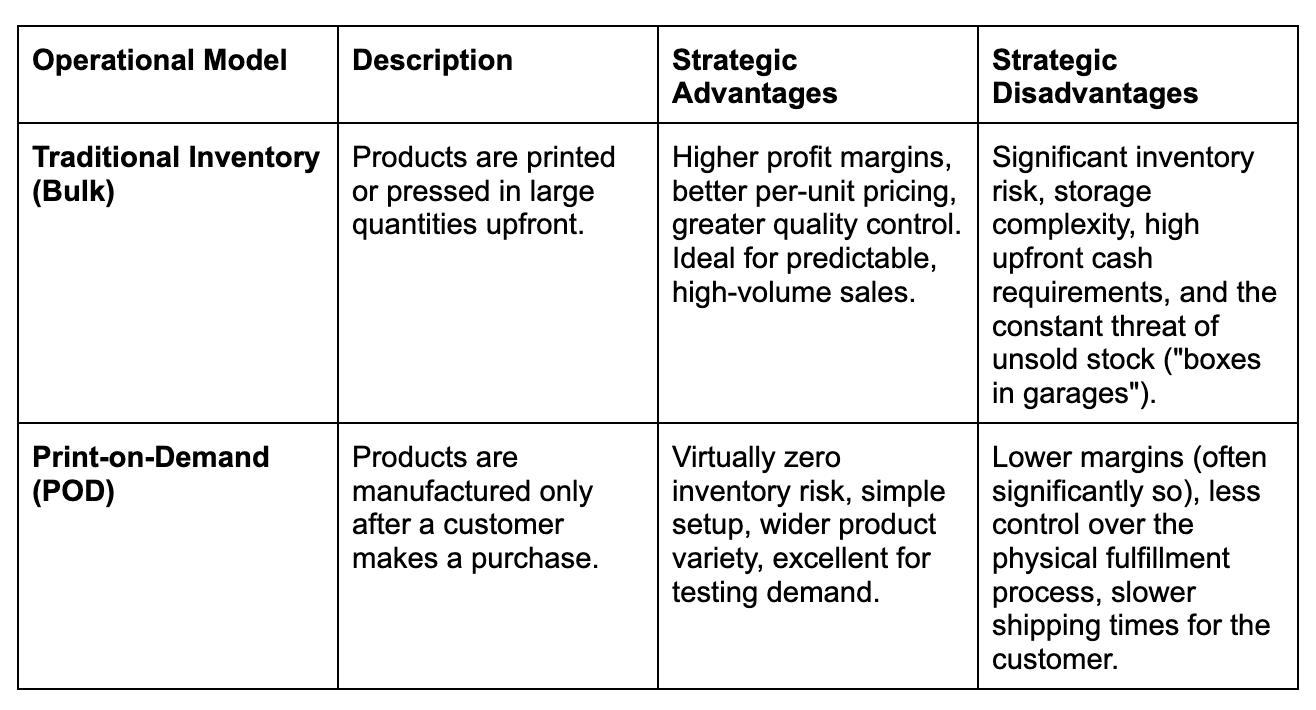
For the vast majority of community and non-profit choirs, risk avoidance is more important than margin maximization. A slightly lower margin on a successfully sold item is far better than having a basement full of outdated, unsold merchandise. POD models allow ensembles to experiment with new designs and products without sinking thousands of dollars into inventory that might not move.
Part IV: Internal Strategy: Timing and Belonging
Two critical elements of merchandise strategy are often systematically underused by choirs:
1. Emotional Timing
Merchandise sales are driven by emotion, not rationality. The optimal time to sell products is immediately after a moment of high emotional impact. This window includes:
Right after a standing ovation at a major concert.
Following a significant competition result or award.
During a holiday performance or a tour sendoff.
Immediately following an anniversary or farewell celebration.
A moderately designed shirt sold right after a powerful, tear-jerking performance will almost always outperform a beautiful shirt sold weeks later on a quiet website.
2. Internal Belonging Merchandise
Most choirs focus primarily on selling to the audience. This is a mistake, as the singers themselves are often the best, most reliable customers.
Merchandise created for the ensemble members reinforces community identity internally while simultaneously serving as free, mobile advertising externally. Powerful examples include:
Section hoodies or T-shirts (e.g., “Tenors Rule”).
Limited-run Tour or Festival apparel.
Inside-joke items that genuinely reflect the group’s culture.
Alumni or Anniversary collections.
These products tap into shared experience and group identity, making them inherently more compelling and desirable than generic public-facing merch.
Final Thought: The Future is Ecosystems
The dominant narrative that physical media is dead forever may be premature. Vinyl made a massive resurgence because people missed the physical connection and permanence. As consumers grow frustrated with subscription fatigue, algorithmic platforms, and the ephemeral nature of content, there is a rising desire to support creators directly.
The underlying shift is away from the old industrial model—make product, sell product—and toward a community ecosystem model. The choir itself—the experience, the identity, the relationships—is the core offering. Merchandise and recordings are simply powerful extensions of that emotional ecosystem.
Choirs are not transactional businesses; they are communities first. The ensembles that succeed in the new economy are those that stop treating merchandise like random fundraising clutter and start treating it as vital community infrastructure. When used strategically, recordings and merch strengthen loyalty, deepen relationships, amplify visibility, and ultimately, create a modest but sustainable revenue stream that fuels the mission.